
Cartels, Corruption & Cross-Border Trade: How Mexico Became The Epicentre Of Gang Violence
Curated By :
Last Updated:February 23, 2026, 10:23 IST
The killing of drug lord Nemesio Ruben Oseguera Cervantes, better known as “El Mencho”, has brought the spotlight on the historical roots and evolution of gang violence in Mexico
resetRapid ReadRapid ReadSummarized by AI.+The death of cartel leader “El Mencho” highlights Mexico’s deep-rooted gang violence, fueled by corruption, cross-border trade, and US demand. Cartel power persists, with militarized groups and retaliatory violence impacting society and governance. More Rapid Read Like this summary?Share Your Feedback
In one of the most significant setbacks to organised crime in Mexico in recent years, drug lord Nemesio Ruben Oseguera Cervantes, better known as “El Mencho", was wounded in a Mexican military operation and died while being flown to Mexico City on Sunday.
Oseguera, the 59-year-old leader of the Jalisco New Generation Cartel, had a $15 million US bounty on his head. According to AFP, he is one of the biggest Mexican drug lords to be taken down since the capture of the founders of the Sinaloa cartel, Joaquin “El Chapo" Guzman and Ismael Zambada. Both are now serving time in the United States.
Recommended Stories
- Mexico News LIVE Updates: Highways Blocked, Vehicles Torched, Flights Ops Hit After ‘El Mencho’ Killed
- What to know about killing of a powerful cartel leader in Mexico
- Who Was El Mencho, Most Wanted Drug Lord Whose Killing Has Triggered Unrest Across Mexico?
- Mexico's Most Wanted Drug Lord ‘El Mencho’ Killed In Military Op, Cartel Starts Nationwide Rampage
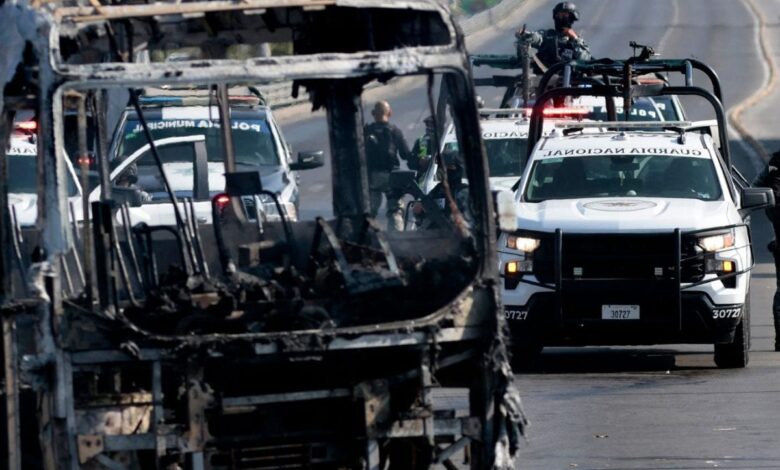
The top cartel boss’s killing has triggered a wave of violence across the country, including road blocks and flight cancellations. Jalisco’s capital, Guadalajara, was turned into a ghost town on Sunday night as civilians hunkered down. School was cancelled in several states on Monday and authorities in Jalisco, Michoacan and Guanajuato reported at least 14 dead, including seven National Guard troops. Videos circulating on social media showed smoke billowing over the tourist city of Puerto Vallarta in Jalisco, and people sprinting through the airport of the state’s capital in panic.
The Jalisco New Generation Cartel is one of the most powerful and fastest growing criminal organisations in Mexico and began operating around 2009. In February 2025, the Trump administration designated it as a foreign terrorist organisation.
AP reported that the Jalisco cartel has been one of the most aggressive in its attacks on the military, including on helicopters, and is a pioneer in launching explosives from drones and installing mines. In 2020, it carried out an assassination attempt with grenades and high-powered rifles in the heart of Mexico City against the then head of the capital’s police force and now federal security secretary. It is one of the main suppliers of cocaine to the US market and, like the Sinaloa cartel, earns billions from the production of fentanyl and methamphetamines.
El Mencho’s death and the immediate retaliatory violence shows both the persistence of cartel power and the volatile interplay between state efforts to enforce the law and decades of gang-related conflict.
It also brings the spotlight on the historical roots and evolution of gang violence in Mexico, from earlier cartel wars and mass atrocities to the modern era of decentralised, militarised criminal organisations and their impact on society and governance.
THE BEGINNINGS
Much before modern-day cartels, northern Mexico had smuggling networks tied to the Mexican Revolution (1910-1920) where weapons, liquor, and contraband flowed across a porous border. During the US Prohibition (1920-1933), alcohol smuggling created organised criminal routes. From alcohol, the trade moved to opium and marijuana from the 1940s-60s as cultivation in states like Sinaloa grew under tacit protection from corrupt officials.
This period successfully established smuggling routes, corrupt political/criminal connections, and a culture of cross-border smuggling.
THE 1980s: A TURNING POINT
The routes of cocaine smuggling changed to Mexico because of the crackdowns by the United States, which affected the Colombian routes via the Caribbean.
The news headlines at that time were characterised by the Guadalajara Cartel, which was dominated by Miguel Ángel Félix Gallardo and was responsible for the centralisation of trafficking in the 1980s. After the death of DEA agent Enrique Camarena in 1985, there was growing US pressure on Mexico. The Guadalajara Cartel split into different cartels, which included the Sinaloa Cartel, Tijuana Cartel, and Juárez Cartel. Just like in every other family, division in this case also led to turf wars.
THE 2006 DRUG WAR & MILITARISATION
In 2006, President Felipe Calderón began a military campaign against the cartels. But rather than weakening them, this action caused the cartels to split up into smaller violent groups, more turf wars, and the militarisation of organized crime.
In 2010, cities such as Ciudad Juárez were some of the most violent in the world. New groups had also appeared, including Los Zetas, who were ex-special forces soldiers, and Jalisco New Generation Cartel (CJNG), who were led by El Mencho.
HOW DID MEXICO BECOME THE HUB OF GANG ACTIVITY?
First of all, Mexico has an over 3,100 km long shared border with the US, giving it the strategic benefit of being situated between South American cocaine manufacturers and American consumers. Additionally, Mexico has extensive coastlines (Pacific and Gulf), making trade simpler. The US is one of the biggest illicit drug markets in the world. In short, where there is demand, there is sure to be supply.
In addition to this, corruption has also fueled the fire. For many years, one-party rule in Mexico under the Institutional Revolutionary Party enabled a kind of tacit agreement between the government and drug cartels. However, with the expansion of democracy in the 2000s, such unofficial agreements broke down, and violence escalated.
Deportations from America are also an important factor in this situation. In the 1990s, the US deported thousands of gang members to Central America, fueling the rise of Mara Salvatrucha and Barrio 18. These gangs destabilized El Salvador, Honduras, and Guatemala, fueling the criminal pipeline in Mexico.
Legally purchased high-powered guns in some parts of the US also regularly end up in Mexico, making cartels more powerful.
Structurally speaking, Mexico sits at the intersection of production (South America), transit (Central America and Mexico), and consumption (United States). Add corruption, inequality, youth unemployment, and weak policing and you get a long-term violence cycle.
News18 NewsletterHandpicked stories, in your inboxA newsletter with the best of our journalismsubmittags :drug-traffickingMexican drug cartelsMexicoSouth AmericaUnited statesClick here to add News18 as your preferred news source on Google. Stay updated with the latest news updates along with key india news and world news. Explore viral news, politics, city news, explainers, and expert opinions on News18. Join the fun, play games on News18. Download the News18 App to stay updated!view commentsLocation :Mexico City, MexicoFirst Published:February 23, 2026, 10:23 ISTNews explainers Cartels, Corruption & Cross-Border Trade: How Mexico Became The Epicentre Of Gang ViolenceDisclaimer: Comments reflect users’ views, not News18’s. Please keep discussions respectful and constructive. Abusive, defamatory, or illegal comments will be removed. News18 may disable any comment at its discretion. By posting, you agree to our Terms of Use and Privacy Policy.Loading comments…Read More